Web 2.0: Social and Collaboration

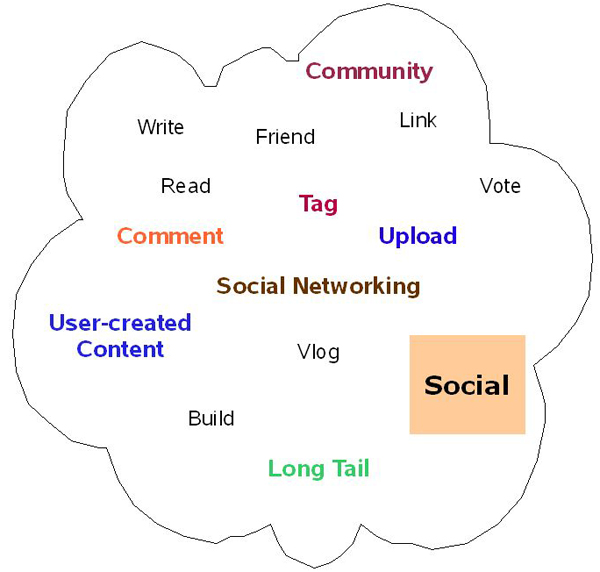
The social and col­lab­or­a­tion part of Web 2.0 mostly revolves around the con­cepts of social net­work­ing, user-gen­er­ated con­tent, and the long tail.

Social CloudSocial Cloud

Social net­work­ing is the idea that people can meet and talk and organ­ise their social lives using the Web instead of, or in addi­tion to, more tra­di­tion­al meth­ods such as talk­ing face to face, or on the phone. It’s an exten­sion of usen­et and bul­let­in boards that’s based on the web, with more fea­tures. Social net­work­ing sites tend to go through phases; every­one was into Orkut for a while, now it’s MySpace and Face­book, or Ravelry if you’re a knit­ter. Fea­tures and focus vary, but the idea of cre­at­ing an online com­munity remains the same.

User-gen­er­ated con­tent is the idea that non-pro­fes­sion­als can con­trib­ute con­tent. I don’t like the term much, so I’m going to use the vari­ant user-cre­ated con­tent to show that it’s a cre­at­ive pro­cess, not just some machine gen­er­at­ing con­tent. The concept of user-cre­ated con­tent isn’t new; the Web was first designed as a col­lab­or­a­tion plat­form, the read/write web. In prac­tic­al terms, how­ever, it was dif­fi­cult for those without lots of tech­nic­al know­ledge to pub­lish on the web. All these things like blog­ging and com­ment­ing that are now rel­at­ively easy for people to do wer­en’t, just a few years ago. Pre­vi­ously only a few people could make their opin­ions widely known, in prac­tice pro­fes­sion­als with access. Don’t for­get that one of the reas­ons Ben­jamin Frank­lin could make such a dif­fer­ence in the early years of the US was that he owned a print­ing press!

Now basic­ally every­one with access to the inter­net who’s inter­ested can pub­lish their opin­ions, their pho­tos, or their videos to their friends and the world. It’s easi­er to keep in touch with friends far away, or find out what life’s like in some far-off place, or con­trib­ute a snip­pet of know­ledge to Wiki­pe­dia. Some of these pub­lish­ers (blog­gers, com­menters, photo-upload­ers) have a large audi­ence, many have an audi­ence that is large enough for them (which may mean just the fam­ily, or just them­selves, or a few hun­dred strangers).

One of the down­sides of this “demo­crat­iz­a­tion”, as it’s some­times called, is that it can be hard to find the really good inform­a­tion or enter­tain­ment — you hear a lot about “cult of the ama­teur” and “90% of everything is crap”. Some of this is com­ing from those who are threatened by the avail­ab­il­ity of inform­a­tion from oth­er sources: journ­al­ists and news­pa­pers in par­tic­u­lar are right to be scared, since they’re now going to have to work harder to con­vince the world that they add value. Wheth­er the enter­tain­ment cre­ated by ama­teurs that’s avail­able on the web is bet­ter than that cre­ated by the mass enter­tain­ment industry depends on your view of how good a job the lat­ter does at find­ing and nur­tur­ing talent.

The long tail is anoth­er aspect of Web 2.0 that you hear about a lot. Book­sellers are a good example of how the long tail works: Where­as your aver­age book­seller, even Water­stones or Black­well’s, has maybe a few thou­sand or a few tens of thou­sands of books, an inter­net seller can have mil­lions. Although the com­par­is­on is per­haps not fair, since an inter­net book­seller, just like your loc­al book­seller, can order from the pub­lish­er and will usu­ally count that as being part of the invent­ory for brag­ging reas­ons. And, of course, you can always go to Pow­ell’s Books in Port­land, which claims to have over a mil­lion books phys­ic­ally in their store. It’s big; they hand out maps at the entrance so you don’t get lost.

The long-tail aspect is this: It turns out that most of the rev­en­ue does­n’t come from selling the Harry Pot­ter books, big sellers though those are, it’s from selling those books that aren’t indi­vidu­ally big sellers. The total volume of sales in those niche areas is lar­ger than the best-sellers. Oth­er com­pan­ies that make good use of this of course are eBay, where you can buy things that you can­’t get down­town, uptown, or poten­tially any­where in your town, and the video rent­al com­pany Net­flix, which rents out some 35,000 titles in the one mil­lion videos it sends out each day.

And, of course, the long tail applies to blogs and oth­er online sites. In oth­er words, no mat­ter how spe­cial­ised your blog is, someone out there in blog-read­ing land is likely to find it inter­est­ing. The big prob­lem is how those poten­tial read­ers find out about it.

One of a series on Web 2.0, taken from my talk at the CSW Sum­mer School in July 2007. Here’s the series intro­duc­tion. Com­ing up next: tech­nic­al aspects of Web 2.0

Web 2.0: Buzzwords

Like any hyped tech­no­logy, Web 2.0 has a lot of buzzwords. They include the tag (as in tag cloud), the folk­sonomy, the long tail (more about that in a later post), and social soft­ware.

Social soft­ware is there to sup­port net­work­ing and social activ­it­ies via the inter­net. Lots of people spend lots of time inter­act­ing with friends online, wheth­er they’ve ever met them in per­son or not. For people who are embed­ded in that world, it’s a nat­ur­al way to inter­act. For every­one else, it can be slightly creepy to think that com­plete strangers read everything you write and know a lot about you. Lots of real-life friend­ships have blos­somed from online activ­it­ies, and more than a few prob­lems have occurred as well. The social aspect, that is people inter­act­ing with oth­er people, is prob­ably the most import­ant aspect of Web 2.0 sites.

The idea behind tags is to label things, so they’re loosely related to cat­egor­ies or (even more loosely) onto­lo­gies. Tags typ­ic­ally aren’t applied by spe­cial­ists; in keep­ing with the Web 2.0 philo­sophy they are applied by the per­son writ­ing the blog post, or upload­ing the photo, or stor­ing the book­mark. So you get near-duplic­a­tions, mis­spellings, incor­rect usages, double mean­ings etc., but at least you do have some sort of cat­egor­isa­tion applied to these bits of con­tent. And many people go to quite a lot of effort to see what sorts of tags oth­er people use, and then pick the same ones where pos­sible. This then ends up being a folk­sonomy.

Web 2.0 Tag CloudThis image shows a tag cloud, which is a col­lec­tion of tags where the tags in big fonts are the more import­ant ones (usu­ally means they show up more often). Unlike say top­ic maps or RDF, the spa­tial dis­tri­bu­tion of the tags does­n’t usu­ally mean any­thing, although in the­ory you could use it to show rela­tion­ships between the tags. Since gen­er­ally there is no form­al rela­tion­ship between them (oth­er than that from nat­ur­al lan­guage) this would be tricky to auto­mate and most people just fiddle with the cloud to make it look nice. 

The oth­er buzzwords on the slide are the import­ant ones from a couple of years ago, these days there would be a few more. There’s also a ver­sion of the slide with the words linked to the rel­ev­ant Wiki­pe­dia articles.

One of a series on Web 2.0, taken from my talk at the CSW Sum­mer School in July 2007. Here’s the series intro­duc­tion. Com­ing up next: social and col­lab­or­a­tion aspects of Web 2.0

Web 2.0: Introduction

At the CSW XML Sum­mer School this year I gave a talk on Web 2.0, in the Trends and Tran­si­ents track. I’ve been pon­der­ing wheth­er to write it up as a series of post­ings or not; there’s so much hype and inform­a­tion around Web 2.0 that many people are bored silly with it now. I decided it’s prob­ably worth­while since I found some ways of organ­iz­ing the fea­tures com­monly asso­ci­ated with Web 2.0 that I haven’t seen elsewhere.

I’ve cre­ated a series of posts, of which this is the first. The links will become act­ive as I pub­lish the posts.

  1. Buzzwords
  2. Social and Collaboration
  3. Tech­nic­al
  4. Pro­cess
  5. Issues

The big thing about Web 2.0 is the concept that lots of people want to have a say, and that many of them have some­thing valu­able to say. The idea is that sys­tems that give people a voice, and that enable them to take part in dis­cus­sions, have value. It’s no longer the case that only spe­cial­ists or celebrit­ies can have their opin­ions pub­lished, ordin­ary people can too. This idea that users can cre­ate the con­tent that oth­er users read or view has its detract­ors of course, but they tend to be out­numbered by the pro­ponents (or is it just that the pro­ponents are louder?).

The mar­ket­ing hype tends to over­shad­ow everything of course, and now we’re get­ting into the silly sea­son where every new idea is labelled with its own Web x.x vari­ant. Pretty soon we’ll be repla­cing the num­ber and append­ing the year, just like happened with oper­at­ing sys­tems, then with names taken from obscure or made-up lan­guages. Web 2.0 as a fea­ture set is, how­ever, worthy of atten­tion, even if the mar­ket­ing hype gets a bit much.

I’m not going to dis­cuss new devel­op­ments such as Google’s OpenSo­cial API in this series; it’s too new for me to be able to say any­thing use­ful on wheth­er it will change the big pic­ture, or just the details.

If you’re look­ing for a pub­lic­a­tion with a lot of detail, try O’Reilly’s Web 2.0 Radar Report. It’s expens­ive, but it has a lot of mater­i­al and ref­er­ences in it, as well as recom­mend­a­tions for best prac­tices. Worth read­ing if you have to make bet-the-com­pany busi­ness decisions about this stuff.

Customizing Google

For those, like me, who are some­what pri­vacy-ori­ented, and use Fire­fox as their browser, I recom­mend using the Cus­tom­ize Google exten­sion. I set it up to use https for access­ing Google docs, read­er, and cal­en­dar, and to anonym­ize the Google ID for search­ing. You can also anonym­ize the Google ana­lyt­ics cook­ie, which I’m not doing for the time being. It has a bunch of oth­er fea­tures that might be of interest as well, such as set­ting vari­ous pref­er­ences or tak­ing selec­ted sites out of search res­ults (e.g., adult sites for your kids). I’ve been using it for a month and have had no prob­lems with it.